Decision Intelligence for Airlines: Beyond Dashboards and Reports
Airlines have more data than ever – from bookings, customers, agencies, sales pipelines, transactions, and operational systems. Yet getting from a signal in that data to a clear decision can still take far too long.
A commercial team may need several reports to understand a change in agency performance. A sales team may need to compare booking history, contract usage, and CRM activity before deciding which account deserves attention. An operations team may see a booking error but spend hours comparing alerts, logs, APIs, and external-system responses to find the cause.
The issue is not a lack of data. It is the distance between data and action.
That is where decision intelligence for airlines comes in.
Industry Pain Points & Challenges
Airlines operate in complex, multi-system environments where critical data remains fragmented across legacy booking engines, inventory databases, revenue management solutions, and CRM platforms. While traditional Business Intelligence (BI) tools provide visibility through static dashboards, they fall short of providing actionable guidance at the point of decision-making.
Key industry challenges include:
Data Integration Barriers: Inconsistent data formats and isolated system silos hinder real-time end-to-end analysis across commercial and operational teams.
Traditional BI Limitations: Dashboards only answer what happened, leaving teams to manually piece together logs and reports to understand why an issue occurred.
Clear System Boundaries: Decision intelligence does not replace underlying transactional engines or alter core execution flows; rather, it provides context and recommendations to bridge the gap between insight and action.
From visibility to action
Traditional airline business intelligence remains essential. Dashboards, reports, and historical KPIs help teams understand business performance. But they often answer only one question: What happened?
Teams still need to establish:
Why did it happen?
Is this a meaningful change or normal variation?
Which route, agency, customer, account, or booking stage is affected?
What should the responsible team investigate next?
This gap is becoming more important as airline technology environments grow more connected. SITA reports that 83% of airlines see data-driven decision-making as a strategic priority, yet 49% identify data integration and consistency as their main barrier.
The opportunity is not simply to add more dashboards. It is to make the information already available easier to understand and use at the moment of a decision.
What decision intelligence means
Decision intelligence for airlines connects data, analysis, business context, and recommendations.
It helps teams move through a more useful sequence:
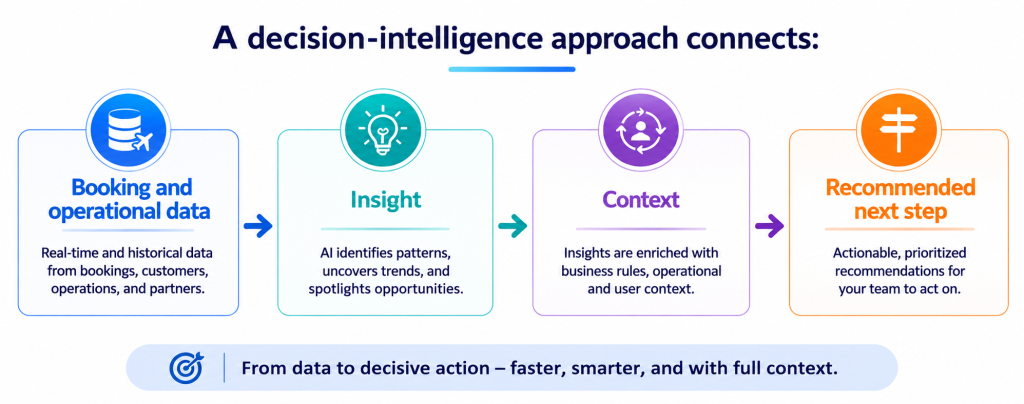
For example, a report may show that a corporate account’s booking activity has changed. A decision-intelligence approach can help compare that activity with the account’s usual behaviour, bring together relevant booking and revenue context, and help the account owner determine whether the change requires a renewal, retention, upsell, or service conversation.
The technology does not make the final decision. It gives the responsible person better context before they make it.
Introducing Aura
Aura is an AI-powered decision intelligence tool for the travel industry. It sits above existing booking and transaction systems, helps internal airline teams turn operational data into reports, insights, recommendations, and monitoring visibility.
Aura is designed for commercial, revenue, sales, operations, technology, and executive teams – not only data analysts.
Its role is simple: help teams get a clear answer, understand what matters, and identify where to focus next.
Ask questions without SQL
Aura enables teams to ask questions in plain English, such as:
- Show me this year’s booking report for X region.
- Generate the agency performance report for Q3.
- Which markets experienced the largest booking change this month?
The result can be delivered as a table, report, dashboard, chart, or graph. This makes airline data analytics more accessible while reducing dependence on manual report requests for routine questions.
Turn insight into action
Aura goes beyond reporting by helping users interpret changes and prioritize the next step. It can support customer benchmarking, sales prioritization, conversion and revenue prediction, contract renewal intelligence, upsell opportunities, and executive summaries.
For instance, an account manager can compare a customer’s current spending or booking pattern with its historical benchmark, then use that context to determine whether the account requires review.
Monitor the booking journey
Aura also supports airline booking pipeline monitoring. It tracks request volumes, error rates, latency, alerts, and service performance across booking stages, from Shopping and Select Flight through Booking, Payment, Ticketing, Seat Selection, and ancillary services.
It helps teams connect a user-facing error with internal API behaviour and external-system responses, so investigations can begin with stronger context.
The next step for airline intelligence
The future of airline operations monitoring and commercial analysis is not more disconnected data. It is a connected view that helps people understand what is happening and act while the signal still matters.
Aura does not replace booking systems, create live offers, execute transactions, or replace human judgment. It helps airline teams use the systems and data they already have to move from fragmented information to better-supported decisions.
Turn booking data into better decisions
Aura brings plain-English reporting, business insight, recommendations, and booking-pipeline visibility into the decision process.
Whether the priority is improving commercial visibility, supporting revenue and sales decisions, or investigating booking-pipeline issues faster, Aura helps teams get from a question to a clearer next step.
Explore how Aura can support faster, better-informed decisions across your airline